Emergency Tarp and Dry-In Service in Fort Smith, AR
Commercial Roofing Services
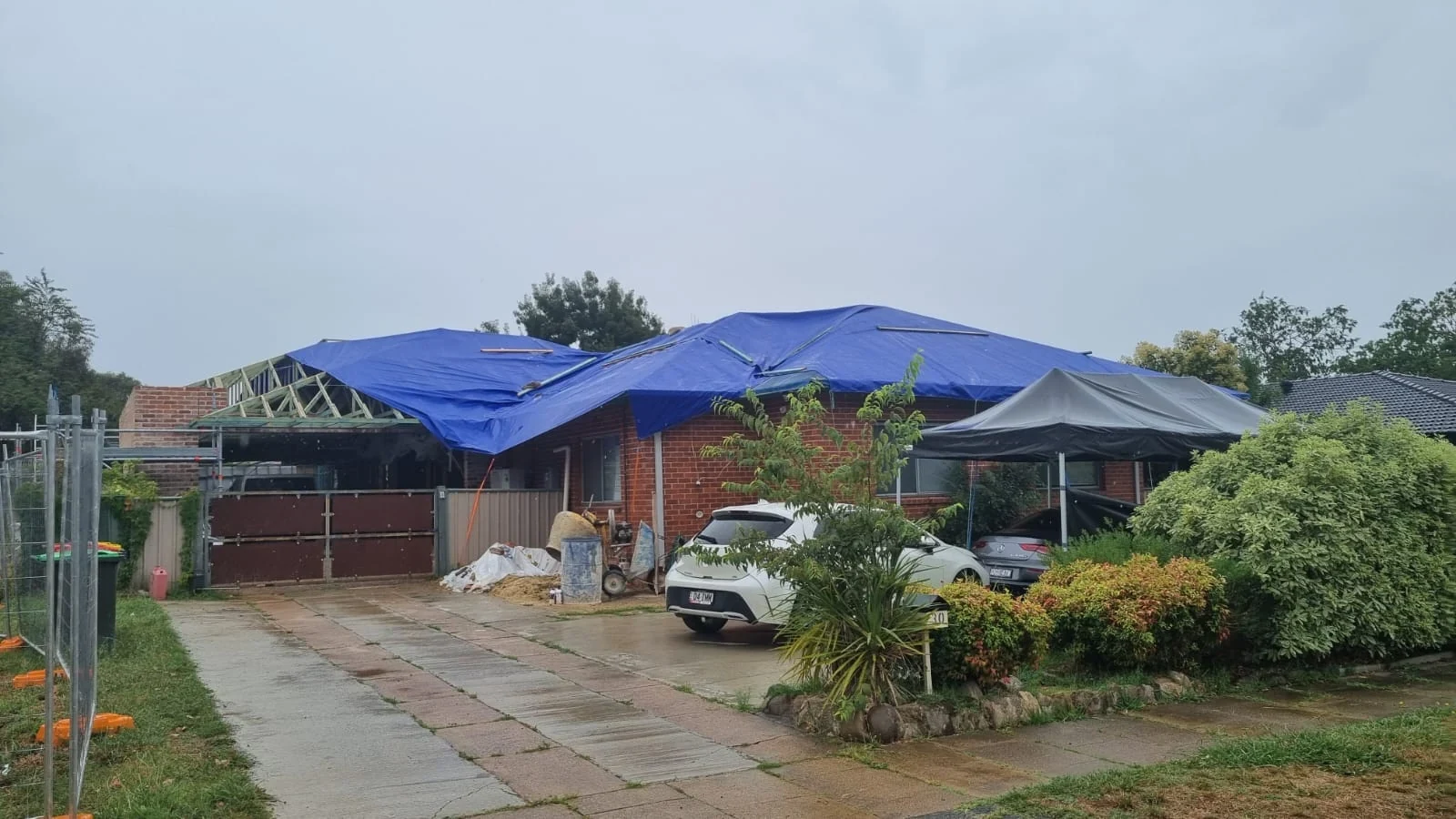
Emergency Commercial Roof Repair in Fort Smith
The hours right after a roof opens up matter more than almost anything that happens later in the repair process. Water sitting on exposed insulation, inventory getting rained on inside a warehouse, or a manufacturing floor with equipment under an active leak turns a roof problem into a much bigger loss fast. Emergency dry-in exists to stop that clock, not to be the final repair.
What Counts as an Emergency
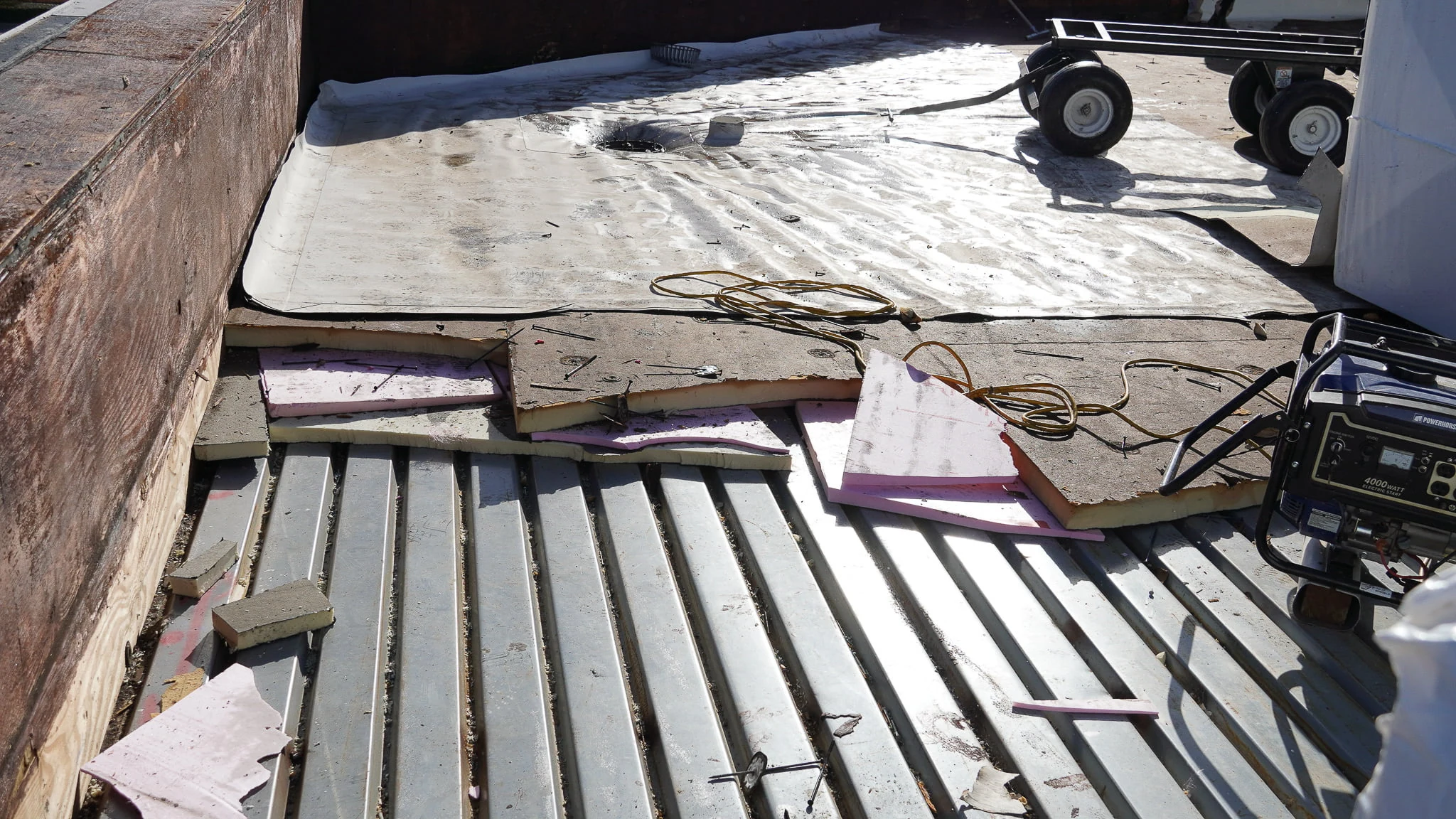
Torn or missing membrane sections after wind, a puncture from tornado debris, a tree limb or blown equipment through the roof, or hail damage severe enough to open the membrane are the calls we treat as emergencies. The common thread is active or imminent water intrusion into a building that is still occupied, still storing inventory, or still running production.
Not every storm-damaged roof needs an emergency response. Surface hail bruising with no active leak can typically wait for a scheduled repair. We assess severity honestly on the call rather than treating every storm as a rush job.
What Dry-In Actually Involves
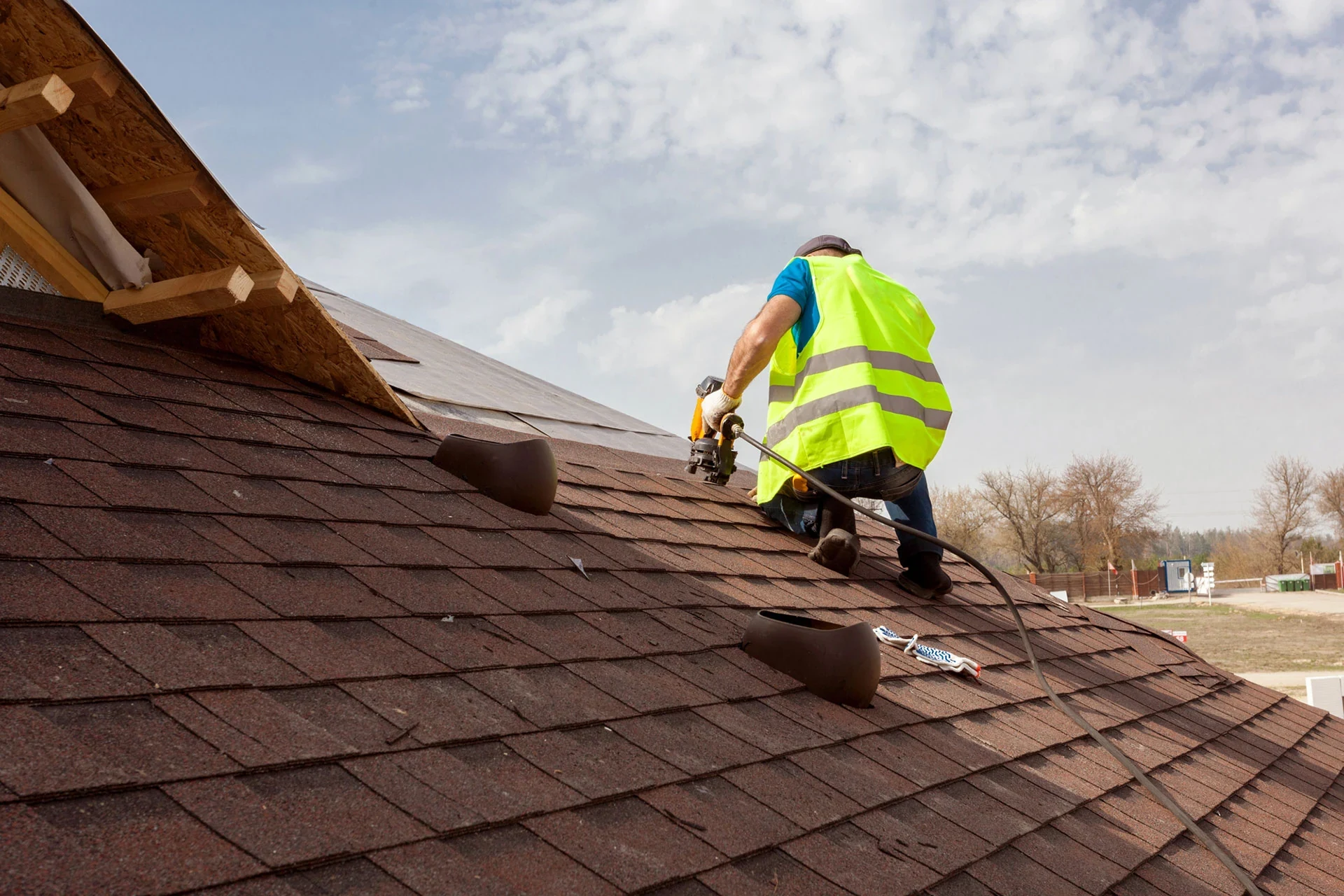
Dry-in means securing the damaged area against further water entry using tarps, mechanically fastened cover, or temporary membrane patches, depending on the size and location of the damage. On a low-slope roof, that often means a heavy tarp anchored with battens and fasteners around the perimeter of the damaged zone, sealed tight enough to shed rain until permanent repair can be scoped and scheduled.
This is a temporary measure. A tarp is not rated to hold up indefinitely, especially through repeated wind events, so we follow up with a plan for permanent repair rather than leaving a temporary fix in place as the long-term answer.
Protecting What's Underneath
For a distribution or trucking facility, water intrusion threatens inventory and product on pallets that cannot easily be moved out of the way on short notice. For a manufacturing plant, it threatens equipment that does not tolerate moisture. We prioritize the dry-in location and sequence based on what is directly underneath, working with facility staff to identify the highest-risk areas first if the damage spans more than one section of roof.
Response Timing
We treat emergency calls as emergency calls. When a storm has come through Sebastian County and left active roof damage, getting a tarp or temporary seal in place before the next rain is the priority, ahead of paperwork or scheduling convenience. Severe weather here tends to move through in clusters, so a roof left open after one storm is often at risk from the next system behind it.
Coordinating With Facility Staff During an Active Event
Emergency dry-in works better when whoever runs the building is part of the plan, not finding out after the fact. We check in with facility staff on which areas below the roof are highest priority, whether that is a server room, a section of finished inventory, or a production line that cannot tolerate any moisture, so the crew tarps in an order that matches what actually matters most to the operation.
Access matters too. A crew showing up to a locked yard or a gate they cannot reach loses time that matters during an active leak, so we confirm access arrangements as part of the initial call whenever the site has restricted entry, including facilities near controlled areas around the regional airport and Air National Guard base.
Off-hours calls are common with storm damage, since severe weather does not keep business hours. We treat a call at two in the morning with the same urgency as one at two in the afternoon when active water intrusion is involved, because the roof does not care what time it is.
What an Emergency Response Includes
- Rapid assessment of damage severity and water intrusion risk
- Temporary tarp or mechanically fastened cover over the affected area
- Interior coordination to protect inventory or equipment directly below the damage
- Photo documentation of the damage before and after temporary repair
- A follow-up plan and timeline for permanent repair or replacement
- Coordination with your insurance documentation process where applicable
Emergency Dry-In Questions From Fort Smith Building Owners
How fast can a tarp-over happen after a storm?
Active water intrusion into an occupied building gets priority response. Timing depends on storm scale and how many calls are coming in at once across the area, but we move active-leak buildings to the front of the queue.
How long can a temporary tarp stay in place?
A tarp is meant as a short-term measure. It can hold through several weeks in moderate conditions, but repeated wind events or extended exposure increase the risk of failure, so we work toward permanent repair as soon as it can be scheduled.
Do you document damage for insurance purposes during the emergency visit?
Yes. We photograph the damage before covering it and document the temporary repair itself, since that record often matters for the claims process that follows.
What if the damage covers a large section of roof rather than a single spot?
We prioritize sections based on what is underneath and the risk of continued water intrusion, tarping the highest-risk areas first if we cannot cover the full damaged area in one visit.
Does a tarp-over count as the permanent repair?
No. It is a stopgap to stop water intrusion while permanent repair or replacement gets scoped, priced, and scheduled. We do not treat a tarp as a finished job.
Document the condition before choosing the scope
A decision-grade Fort Smith roof record includes interior leak locations, roof access, water paths, membrane and flashing defects, drainage conditions, temporary work, and photographs taken before conditions change. Conditions should be organized by roof area and priority rather than buried in a chronological photo dump. During the visit, the technician should stabilize the immediate opening, protect the occupied area, and document the conditions that still require permanent work. Wide views, detail views, measurements, markings, and interior references make the findings reproducible instead of dependent on memory. Temporary protection, permanent repair, routine maintenance, and capital recommendations belong in separate sections. This keeps a successful dry-in from being mistaken for the completed repair and lets competing proposals be compared on the same basis.
Treat each roof assembly on its own terms
Roof-system identification changes the diagnosis. Around Fort Smith, the target page inventory includes TPO 60 Mil, TPO 80 Mil, and EPDM White, each with its own seam, flashing, fastener, and compatibility questions. The scope should name the membrane or surface that was actually observed, identify unknown construction, and check compatibility before mastics, primers, membranes, or coatings are specified. Core information may be necessary when layers and attachment affect the option set. Drainage stays in the analysis because a sound patch cannot correct water held against a curb, an overloaded outlet, or settlement at a low point. System language should support what is temporary, what can be repaired permanently, and what requires a broader inspection after the weather clears instead of functioning as a product catalog.
Roof work has to fit real operations
Commercial Real Estate REITs, Property Management Firms, and Food Processing Cold Storage do not share the same interruption tolerance. The roof scope should be written around the occupied property as well as the exterior defect. Document roof access, sensitive rooms and inventory, deliveries, public entrances, tenant hours, exhausts and air intakes, interior evidence, and the route used to move tools and debris. These conditions belong in the written scope before scheduling. A dry-in can be appropriate during active weather even when permanent work must wait. The crew's daily record should identify every temporary edge, cover, ballast, drain protection, and remaining exposure before leaving the property.
Make repair, restoration, and replacement distinct decisions
The recommendation must answer what is temporary, what can be repaired permanently, and what requires a broader inspection after the weather clears. An isolated repair, repair program, restoration, recover assembly, and full replacement solve different condition patterns and should not be presented as interchangeable price levels. Decision thresholds include moisture extent, remaining secure attachment, deck condition, prior repair performance, drainage, assembly compatibility, operational risk, budget timing, and the period the owner expects the roof to remain in service. A smaller scope is not automatically prudent, and a larger scope is not automatically safer. The defensible option is the one whose boundaries match the documented condition and the owner's operating requirements.
Turn the visit into a usable next step
The practical handoff is a documented roof inspection once the immediate water entry is controlled. The next person should receive the property address, roof-area identifiers, contacts, access notes, photographs, temporary measures, completed work, open recommendations, and timing. For one building, that history makes the next visit faster and reveals whether a repair held. Across a portfolio, it lets ownership rank roofs by condition, operational risk, repair spending, and capital timing instead of reacting to the newest ceiling stain. The result is more than a completed patch or proposal. It is a controlled sequence from immediate response to documented condition, from condition to an appropriate option, and from that option to scheduled stewardship of the roof asset.
A useful response starts before roof access
Before dispatch, collect the address, responsible building contact, safe access route, occupied area below the problem, time and behavior of the leak, known roof type, and any temporary protection already attempted at the Fort Smith property. The caller should not be asked to diagnose the assembly from the floor. A short description of timing, location, volume, affected equipment, and previous occurrences is more useful than guessing which roof product failed. Clear intake notes reduce wasted roof time and prevent the handoff from losing urgent details. They also create the first event in the roof history that later inspections and repair records can reference.
Price the known work without hiding the unknowns
Pricing is easier to evaluate when the scope shows which conditions were measured, which were observed but not opened, and which remain concealed. Unit prices or allowances can address uncertainty without pretending the quantity is already known. Alternates are useful when they compare real decisions, such as repair versus restoration preparation or recover versus tear-off. They are less useful when major necessary work is moved out of the base price simply to make one proposal appear lower. A reviewable proposal lets ownership compare boundaries, evidence, materials, quantities, disruption, and closeout,not just totals. The goal is a scope that remains understandable after the salesperson leaves the room.
How Fort Smith operating conditions shape the review
Weather around Fort Smith, AR combines severe thunderstorms, hail, wind, high heat, and concentrated heavy rainfall. The timing of that exposure can reveal a weak detail, yet the weather event and the leak source are not automatically the same thing. Interior evidence should be mapped to a roof elevation before anyone chooses a drain, wall, curb, seam, penetration, or edge as the cause. Water can move laterally through insulation, along deck flutes, or down structural elements and appear away from the opening. This distinction protects the owner from treating a correlation as proof. It also lets the next technician revisit the precise unknown instead of repeating the entire investigation.
Fort Smith decision checklist
- Map the interior symptom to a named roof area before selecting a repair detail.
- Record temporary measures separately from permanent work and list every open item.
- Verify drainage, penetrations, walls, edges, earlier repairs, and transitions around the affected area.
- State the observed roof assembly, unknown construction, access limits, and testing assumptions.
- Connect the recommendation to repair, restoration, replacement, maintenance, or capital-planning thresholds.
- Set the next inspection or follow-up date so the roof history continues after this visit.
Commercial roof decision questions
Does this condition automatically mean the roof must be replaced?
No. The review should establish what is temporary, what can be repaired permanently, and what requires a broader inspection after the weather clears. Replacement becomes a defensible recommendation only when the field evidence, moisture, assembly condition, repair history, deck or attachment concerns, and lifecycle comparison support it.
What should the Fort Smith roof scope document?
It should document interior leak locations, roof access, water paths, membrane and flashing defects, drainage conditions, temporary work, and photographs taken before conditions change. It should also label temporary and permanent work separately, state assumptions and exclusions, and identify the inspection or service step that follows the current scope.
How does an urgent call become a maintenance or capital plan?
The immediate visit creates the first roof-area record. A follow-up inspection establishes condition and priorities. Completed repairs, recurring observations, drain service, warranties, and future recommendations are then retained so maintenance stays scheduled and larger work can be placed into the appropriate capital year.
From service call to roof plan
Use the next decision, not the biggest sale.
Stabilize the problem, document the roof, compare the viable paths, and keep the resulting roof history active.