Standing Seam Metal for New Construction Around Chaffee Crossing
Standing seam metal is showing up on more of the new construction going into the Chaffee Crossing business park and the light-industrial buildings feeding off the growth near Ebbing Air National Guard Base. It's a premium system, and for buildings planning to hold long-term, the upfront cost buys real durability against what our weather throws at a roof.
Concealed Fasteners, Real Wind Performance
Standing seam panels interlock along raised seams with no exposed fasteners penetrating the panel field, which eliminates the most common failure point on lower-cost metal systems , fasteners backing out or gaskets failing over time. That matters directly for wind performance, since our spring storms produce uplift pressures that exposed-fastener systems handle less reliably over decades of service.
Panel gauge, seam height, and clip spacing all get engineered to the specific building's height and exposure category, not selected from a generic catalog spec.
We size these systems the same way for a light-industrial building near Chaffee Crossing as we would for a taller structure closer to the Arkansas River, adjusting clip spacing and perimeter fastening zones to each building's actual exposure rather than applying one standard spec across every job.
Snow and Ice Shedding
Our ice storms coat roofs with a weight load that flat membrane systems simply hold in place. Standing seam's slope and low-friction surface shed accumulated ice and snow far more readily, which reduces structural load risk and keeps ice from pooling at parapets and drains the way it can on a low-slope membrane roof.
We do account for snow-guard placement on standing seam roofs near pedestrian entrances or loading docks, since a sudden ice slide off a metal roof is a real hazard if the roof isn't detailed for it.
Ice buildup at valleys and eaves also concentrates weight in specific spots rather than distributing it evenly, and we check those areas of the panel layout closely on any standing seam roof going up in a location with limited winter sun exposure.
Retrofit Over Existing Low-Slope Roofs
Standing seam isn't only a new-construction system , we install it as a retrofit over aging built-up or modified bitumen roofs on some manufacturing buildings, using a structural sub-frame to create slope and drainage where a flat roof previously had none. That approach avoids tear-off entirely on buildings where removing the old roof would be disruptive to ongoing operations.
Panel and Seam Details That Actually Matter
A standing seam roof's performance comes down to a handful of details most owners never see: clip type and spacing, seam profile (snap-lock versus mechanically seamed), thermal movement allowance on long panel runs, and flashing at every ridge, valley, and penetration. On longer industrial buildings we specify:
- Floating clips that allow panels to expand and contract without oil-canning
- Mechanically seamed ridges on higher-wind-exposure buildings
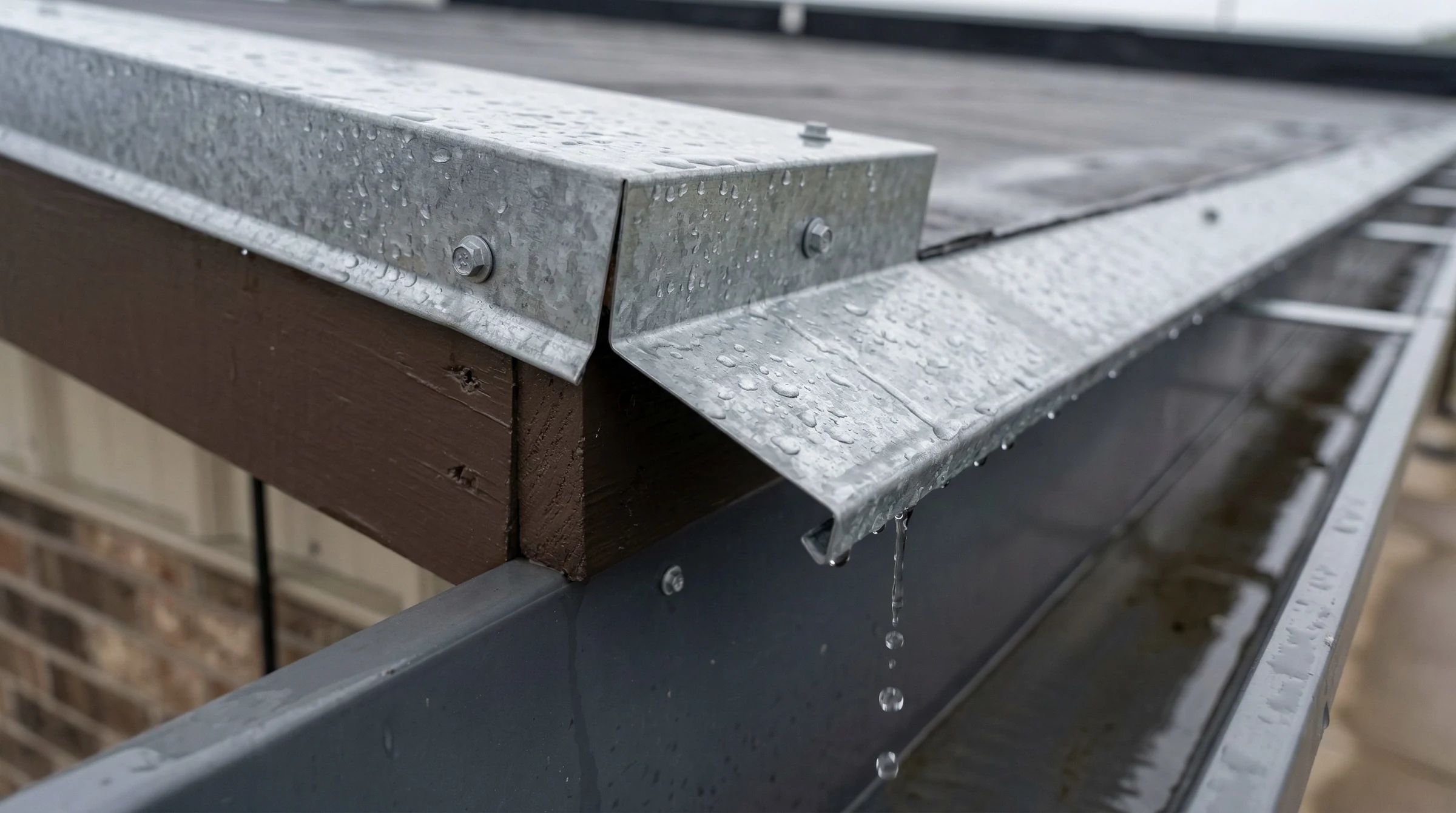
- Extended eave and rake trim to shed water away from wall assemblies
- Butyl sealant at all end laps and transitions, not exposed fastener caulk
- Snow-guard placement at entrances, docks, and pedestrian walkways
What We Check During Installation
Metal roof failures almost always trace back to installation shortcuts rather than the panel material itself , a missed clip, an under-engineered seam, or flashing that wasn't formed to match the actual roof geometry. We inspect seam integrity and fastening at every stage of installation, not only at project close-out.
Insulation and Condensation Control Underneath
A standing seam roof over conditioned manufacturing or office space needs a vapor barrier and insulation package designed for the building's interior humidity, not only an off-the-shelf underlayment. Condensation forming on the underside of a metal panel over an uninsulated or poorly detailed assembly can drip onto product, inventory, or equipment below without ever showing up as an exterior leak, which makes it easy to misdiagnose.
On retrofit projects converting a low-slope roof to standing seam, we pay particular attention to this detail, since the new structural sub-frame changes the airflow and thermal path compared to what the building had before.
Standing Seam Metal Questions We Get in the River Valley
Is standing seam worth the extra cost over TPO for a new building?
For owners planning a long hold period, the durability and low maintenance often justify the upfront cost. For a shorter hold or tighter budget, single-ply may make more sense , we'll run both scenarios with real numbers so the owner can weigh hold period against upfront cost directly.
Can standing seam go over an existing flat roof without tearing it off?
Yes, with a structural retrofit frame that creates slope. We evaluate the existing roof's condition and the building's structural capacity before recommending this approach, since the added frame and panel weight both need to be accounted for.
Does standing seam handle hail well?
Metal roofs generally resist hail better than membrane systems, though panel gauge affects denting risk. We spec heavier gauge on buildings in higher hail-exposure areas, which is most of Sebastian County given our spring storm pattern.
What causes oil-canning on metal panels?
Oil-canning is usually a panel-flatness and clip-spacing issue rather than a defect in the metal itself. Proper clip design and installation minimize it significantly, and we check for it during final walkthrough.
How often does a standing seam roof need maintenance?
Far less than membrane systems, but we still recommend periodic inspection of seams, flashing, and fastener integrity at transitions, particularly after major wind events.